
TL;DR
- No learner without a decorrelated checker — same-model checking is an echo
- Praxist used one model for every role, hiding correlated blind spots
- Checkers must be adversarial, decorrelated, and calibrated — not just present
- Deterministic rules should always outrank learned behavior when they conflict
- Disagreement between independent checkers is signal, not noise to suppress
Somewhere right now, a production AI system is confidently wrong. Not wrong the loud way — wrong the quiet way: a learned shortcut, picked up from watching people accept its output, silently outranking the deterministic rule that would have gotten the answer right. The dashboard shows high confidence. Nothing looks broken. Nobody notices until the mistake surfaces somewhere expensive — because the only thing checking the system's judgment is the system.
We've seen that failure shape enough times, in enough different domains, that it hardened into a design principle we now apply to every learning loop we ship: no learner without a decorrelated checker.
Last week, the research world handed us the cleanest illustration of why it has to be a principle and not a preference.
A funded lab just agreed with most of the checklist
On August 27, Sapient Intelligence — the lab behind the Hierarchical Reasoning Model — released Praxist, an autonomous research system built with collaborators at Tsinghua, Penn, CMU, and NTU, alongside a paper (arXiv:2608.25955). It collected nearly three thousand GitHub stars in its first two days, and it earned the attention: seventeen authors converged on a set of disciplines that most production AI still lacks.
Preregistration. Metrics, evaluation protocols, baselines, and acceptance thresholds are locked before the run. You cannot move the goalposts after seeing the results.
Task-owned evaluators. The code that grades a candidate solution lives outside the code that produced it.
End-to-end provenance. Every claimed improvement carries the lineage and evidence needed to reproduce it.
Negative results as deliverables. A failed run produces an audit report and a recommendation, not silence.
That is real convergence. An independent, well-funded team looked hard at the problem of machines doing research on their own and arrived at pre-commitment, external evaluation, and provenance — the same shape we've been building toward from the production side. When a field starts agreeing on the checklist, the checklist is probably right.
Which makes the one omission stand out.
One model, every role
Read the paper closely and you find that Praxist runs a single model in every role. The model that proposes a solution also — in other instantiations of itself — evaluates the plan, sits on the planning panel, and plays the skeptic. In the published benchmark, one frontier model (DeepSeek V4 Pro, per the authors) occupied every seat across all 75 competitions. The evaluators' "independence" is code-path independence: a separate harness, not a separate mind. Model-level decorrelation isn't mandated, isn't the default, and — most tellingly — isn't discussed. It remains an open gap in self-evolving-agent research.
That gap matters more than any single item on the checklist. Here's why.
Sameness is the failure mode
When a producer and its checker share the same weights, the same training distribution, and the same architectural biases, their errors are correlated. The grader loves the same wrong answers the student does. Agreement between them carries far less information than it appears to — you haven't gotten a second opinion, you've asked the first opinion to speak louder.
Preregistration can't save you there. Pre-committing to a metric protects against moving goalposts; it does nothing about a judge that shares the proposer's blind spots when scoring against that metric. Provenance can't save you either — a perfectly documented lineage of correlated judgments is just a well-organized echo.
The fix is not a smarter model. It is a second check that fails differently, plus a number that tells you how much the check is actually worth.
The principle, in three parts
Adversarial. Something is actively trying to find the error — not passively measuring agreement.
Decorrelated. The checker fails differently from the thing it checks. Two models from different vendors are less correlated than two prompts on one model. A model checked by a deterministic rule — an exact-match lookup, a schema constraint, a regex — is less correlated still. The cheapest decorrelated checker is usually the dumbest one. Resist the urge to make the adversary clever.
Calibrated. Confidence = producer confidence × checker catch rate. If you don't measure how often the checker actually catches errors, it isn't a checker — it's decoration.
What this looks like in production
In the systems we build and operate, the principle shows up as a handful of repeating patterns:
- Divergence as signal. Two models from different vendors extract the same document independently; where they disagree, a human looks. Disagreement is not a bug to suppress — it's the most informative event in the pipeline.
- Deterministic outranks learned. A behavior the system learned from experience never overrides an exact match against ground truth. Learned signal fills gaps; it doesn't win arguments.
- Shadow first. A new learner and its checker both run against a baseline before either one touches production.
- Gates are chokepoints. Human approval sits on exactly one path, with no bypass routes. A gate that can be skipped is not a gate — it's a suggestion.
It holds at research grade, too
This isn't only an ops discipline — it's how we do research. Ananke, the autonomous research system on the SyscallAI platform, splits its roles — proposer, analyzer, judge, adversarial paraphraser — across four separate frontier vendors: four different training runs, four different failure modes, no shared blind spots. Experiments are pre-registered before any run begins; every eliminated candidate is preserved with the evidence that killed it.
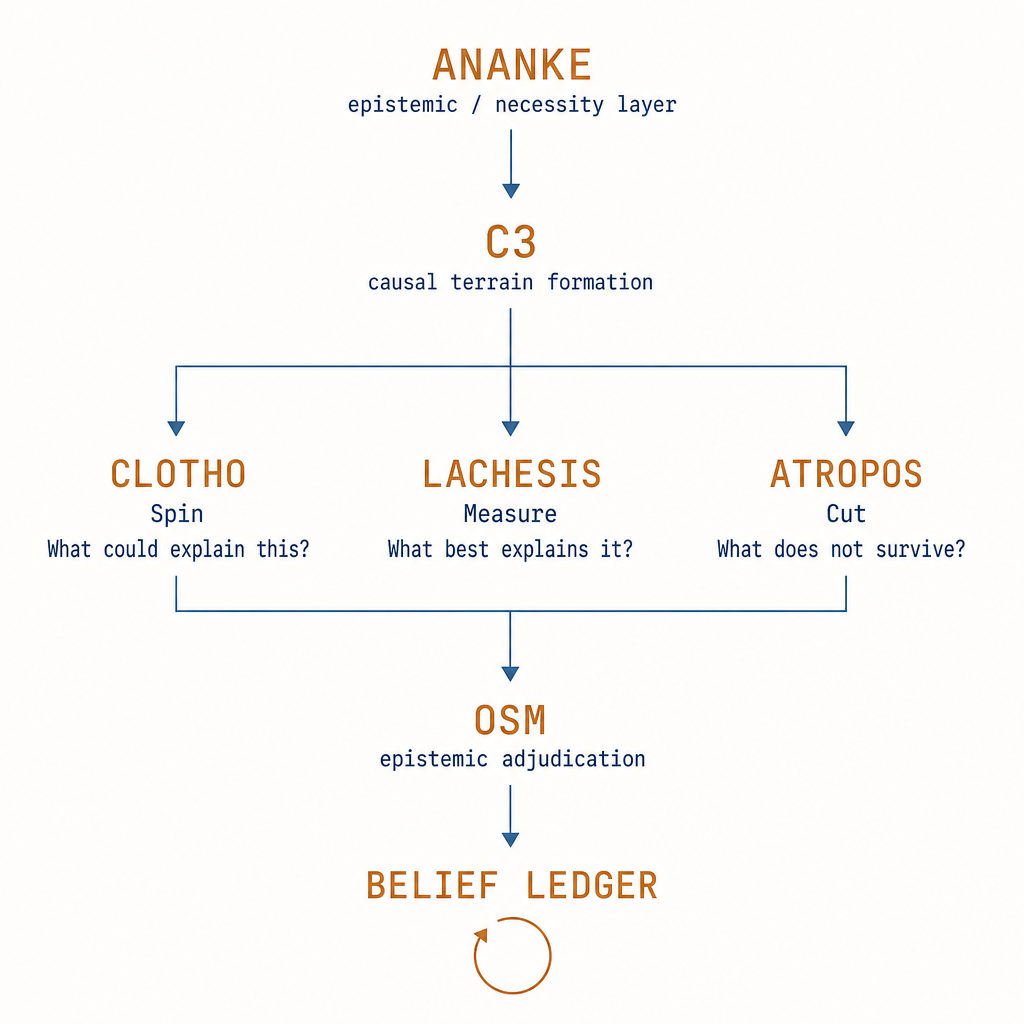
The elimination loop. Diagram: SyscallAI — syscallai.com/systems/ananke
In its first ratified experiment, that architecture produced a +0.044 MRR improvement (about 8% relative) on a sealed holdout, with a confidence interval excluding zero — and then, unprompted, reversed one of its own earlier decisions when fresh evidence demanded it. That reversal is the point. A system checked only by copies of itself defends its past choices; a system checked by minds built differently can afford to change its own.
And the discipline is recursive: FRIDAY, the operational memory system that runs our own company, never reports raw confidence. Every number it produces is discounted by an adversary with a measured catch rate — the same formula, applied to ourselves.
The claim that survives contact
"Our AI learns from your team" is the industry's story right now. The stronger claim — the one that survives the first learned-override incident in front of a customer — is: it learns from your team, and it's checked by something that doesn't.
The research frontier has converged on preregistration, external evaluation, and provenance. Independence of judgment is the part still missing — and it's the part we build first.
If you're building learning systems — or buying them — the architecture conversation is worth having before the first quiet failure, not after. Talk to us.
Aiterated builds AI systems with adversarial, decorrelated checking as a first-class architectural requirement. A companion piece for operators — Why your AI should disagree with itself — is on Metrix Digital's journal.