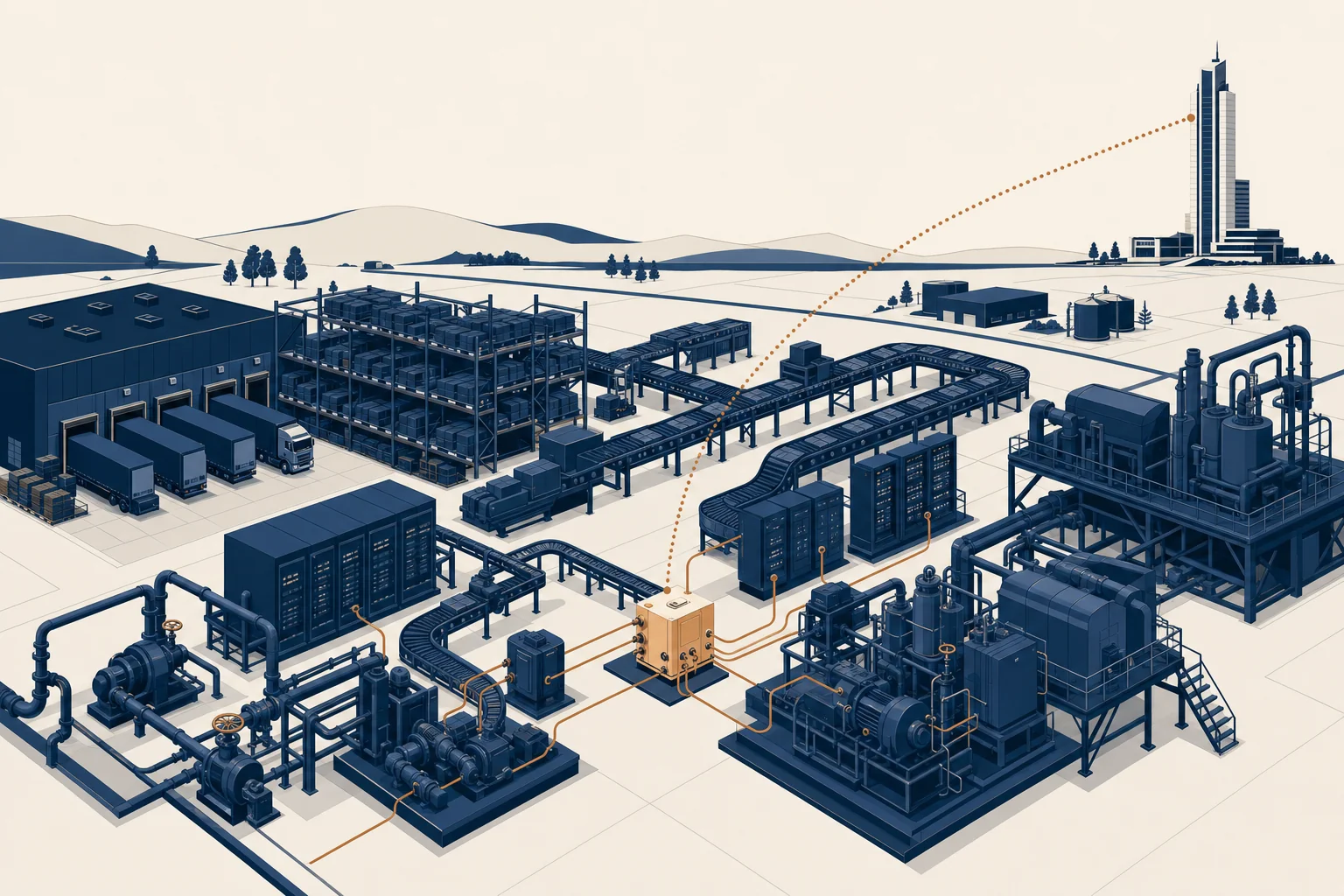
What a forward deployed engineer actually does
A forward deployed engineer is a customer-facing software engineer who builds and ships inside someone else's organization. Rather than developing a product remotely and handing it over, an FDE works alongside the customer's own people — sitting with the operations team, watching how work actually moves, and writing software against that reality.
The role exists because of what people call the deployment gap: the distance between what a capable system can do in principle and what an organization can absorb in practice. Most enterprise AI failures are not model failures. They are integration failures, data failures, and process failures — the model was fine, but nobody had mapped the workflow it was supposed to fit.
Day to day, the job runs in three modes. First, discovery: learning the customer's domain, data, and workflows well enough to know what is worth building. Second, integration: wiring a platform into the systems of record that already exist, which is usually where the genuinely hard engineering lives. Third, iteration: watching real users hit the thing, and changing it in short cycles rather than long release trains.
How is an FDE different from a solutions architect?
A solutions architect designs and advises; a forward deployed engineer ships production code inside the customer's environment. The neighbouring titles — customer engineer at Google and OpenAI, solutions architect at AWS, sales engineer, applied AI engineer, deployment engineer — all involve customer-facing technical work, but they differ in how much of the final software the person actually writes. The FDE sits at the far end of that spectrum: accountable for working software running in the customer's operation, not for a diagram or a proof of concept.
Why the role exists: the Palantir origin
Palantir coined the term. The company's early work with government and large enterprise customers made something obvious that the rest of the software industry would not confront for another decade: for genuinely complex operational problems, you cannot ship a product from a distance and expect it to land. The data is messy, the workflows are undocumented, and the people who understand the domain do not speak in requirements documents.
The name borrows from the military, where a forward-deployed unit is stationed in the field rather than at headquarters. The point is proximity: decisions get made where the information is.
Between roughly 2024 and 2026 the model spread well beyond Palantir. OpenAI, Anthropic, Scale, Ramp, Salesforce and a long list of AI vendors now hire for it, and Andreessen Horowitz has called it the hottest job in startups. The reason is structural rather than fashionable: model capability is now improving faster than organizations can absorb it, and the binding constraint has moved from what the technology can do to how quickly a business can be reshaped around it. The FDE is the industry's answer to that constraint — expensive, human, and deliberately close to the work.
What an FDE costs, fully loaded
Start with the number that actually matters, which is not the one the salary sites lead with. Public compensation aggregators report base salary for the role at around $156,000 on average (Glassdoor, in a $124,000–$198,000 range; 6figr reports $121,000–$207,000). Base is what the employee's salary line says. It is not what the seat costs you.
Total compensation — base plus equity plus bonus — is the honest starting point. Public total-comp data for Palantir- and AI-lab-class forward deployed roles puts mid-level packages at roughly $205,000–$300,000 and senior packages at $300,000–$486,000, with forward deployed software engineer bands reported from about $171,000 to $295,000 and up. Staff and principal packages clear $630,000, but treat those as the ceiling of the market rather than the cost of a hire you are actually contemplating.
Now load it. Payroll taxes, benefits, equipment, tooling, software and overhead conventionally add 25% to 40% on top of total compensation for a US knowledge worker. Mid-level total comp of $205,000–$300,000 at a 1.25×–1.4× multiplier gives $256,000–$420,000 a year — which is where this guide's $250,000–$400,000 band comes from. That is the figure that hits your budget, before the role has produced anything.
Then there is the part that does not appear on any offer letter. Expect three to six months before a new FDE understands your operation well enough to make good calls — you are paying full freight throughout. Retention is a live risk in a market this hot, and when an embedded engineer leaves, much of what they learned about your business leaves with them. The largest cost, though, is a mis-scoped mandate: an expensive engineer building the wrong thing competently, because nobody established where AI actually paid off before the hire was made.

Why this number looks higher than the salary sites
Two different gaps stack up here, and they are worth separating — a reader who sees only $156,000 will reasonably assume this page is inflating.
The first gap is base versus total compensation. Salary aggregators report base pay, and equity plus bonus make up a large share of the package at exactly the companies that hire FDEs — so total comp sits well above the headline. The second gap is compensation versus employer cost: payroll taxes, benefits, equipment and overhead are real money you spend that never appears on the employee's offer letter. None of these figures contradict each other. $156,000 base, $205,000–$300,000 total compensation, and $256,000–$420,000 fully loaded are three answers to three different questions. When you are budgeting a hire, the third is the one that matters.
When hiring one is the right call
Sometimes it plainly is, and it would be dishonest to suggest otherwise. If you have heavy custom integration work at enterprise scale — legacy systems, proprietary data models, real-time constraints, regulatory requirements that rule out off-the-shelf tooling — that work needs an engineer inside the building. No assessment substitutes for someone who can read your schema and ship against it.
If you already have a validated AI roadmap — you know which workflows to change, you have quantified the upside, and the remaining question is execution — then embedded engineering is the correct next investment. The discovery work is done. What you need now is throughput.
And you need the balance sheet to carry it. A $300,000-plus role that may take two quarters to produce its first durable win is a reasonable bet for an organisation that can absorb the variance, and an unreasonable one for a company that needs the investment to pay back inside a year. If all three conditions hold — custom integration at scale, a validated roadmap, and the budget to be patient — hire the FDE. The rest of this guide is for everyone else.
The alternative: evaluate before you embed
Look again at the three modes of the FDE job — discovery, integration, iteration. Most mid-market companies considering the hire need the first one. They are not blocked on engineering capacity; they are blocked on not knowing where AI fits. Hiring a $300,000 engineer to answer that question is an expensive way to buy an answer, and it front-loads the commitment before the answer exists.
That first half can be bought on its own. Parallax runs the discovery work as a fixed engagement: adaptive interviews from the C-suite to the floor, then a synthesis of the gaps between what each level believes is happening. It surfaces the shadow processes nobody documented, the contradictions between levels that no single person can see, and quantified pain in hours and errors and cost.
At a ~60-person hardware distributor, Parallax surfaced 335 operational insights and 66 shadow processes in its first week — including a pricing-trust contradiction that three independent interviews converged on, which leadership did not know existed. That is the input an FDE spends their first two quarters assembling. You can have it in weeks, for a fraction of one month of an embedded engineer, and then decide whether you need the hire at all.
Run the discovery half first
See the cost comparison in full, and take the free five-minute shadow-process scan to get an AI-written readout of what your own answers suggest.
See the FDE alternativeFAQ
What does a forward deployed engineer do?
A forward deployed engineer (FDE) embeds inside a customer's organization to turn AI capability into working software — doing discovery on real workflows, integrating with existing systems, and iterating on-site rather than shipping a product from afar.
How much does a forward deployed engineer cost?
Fully loaded, an FDE typically runs $250,000–$400,000 per year in compensation and overhead at Palantir/OpenAI-class rates, plus a 3–6 month ramp before they know your operation well enough to deliver.
When should a company hire an FDE?
When you have a validated AI roadmap, genuinely custom integration work at scale, and the budget to carry a $300k+ embedded role. If you haven't yet mapped where AI fits your operation, that discovery work comes first — and doesn't require the hire.
What's the alternative to hiring a forward deployed engineer?
Run the discovery half of the FDE job as a fixed engagement first. Parallax interviews every level of your organization to map how work actually happens — shadow processes, bottlenecks, quantified pain — and shows where AI pays off before you commit to embedded engineering.