Reliable AI: Built So a Wrong Answer Cannot Act
Every AI model is sometimes wrong. Reliability does not come from a better model. It comes from the system around it: rules that decide what code can decide, checks that fail differently from the model, and people with the final word whose corrections make the system better.

The Failures Reliability Has to Contain
Confident and Wrong
A model states a wrong SKU, price, or customer with the same confidence as a right one.
Our Approach: Nothing a model produces acts on your systems until it passes validated state and an explicit action contract.
Checks With the Same Blind Spot
A second prompt on the same model agrees with the first, including when both are wrong.
Our Approach: Checkers that use a different signal and fail in a different way from the thing they check.
Silent Failures
An error slips through quietly and surfaces weeks later as a dispute, a return, or a re-ship.
Our Approach: Downstream stages fail loud: they stop bad data before it reaches a customer and say why.
Review That Nobody Measures
An approve button feels like a safeguard, but nobody knows how many errors it actually catches.
Our Approach: People decide the exceptions that matter, and their corrections are recorded against the input that caused them.
Cheap Certainty First. Judgment Last.
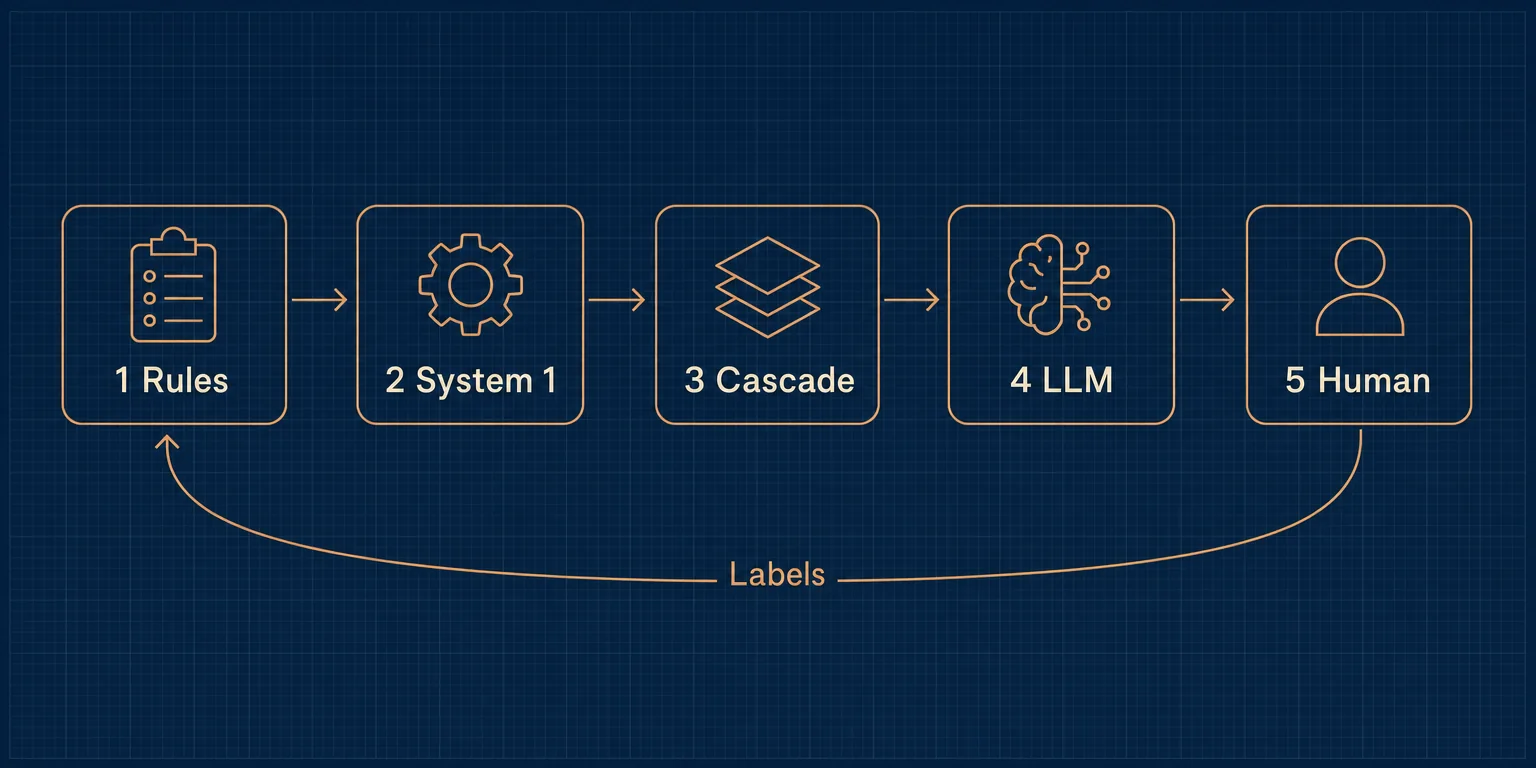
Rules → System 1 → cascade → LLM → human, with every human verdict fed back as a label. Each layer settles what it can and passes on only what it cannot.
Rules
Anything code can decide, code decides. An exact match in your own data outranks anything a model inferred.
System 1
A fast model trained on your own labeled decisions, for the high-volume calls with a fixed set of answers.
Cascade
Independent layers check each other. When they disagree, the case is treated as uncertain and escalates.
LLM
The expensive generalist, used only for what the cheaper layers could not settle.
Human
The final authority. Verdicts come back as labels that confirm or demote what the layers above proposed.
This is our code-deterministic stack: Rules → System 1 → cascade (disagreement means unsure) → LLM → human, with verdicts feeding back as labels. It runs in production in the order-intake and order-QC systems we operate.
Decorrelated and Adversarial by Design
AIterated builds on the SyscallAI platform, a set of systems designed to keep models from acting on what they cannot support. None of them tries to make the model smarter. Each one is built to catch it being wrong.

Hallucination unable to act. OSM wraps the model in an interlock pipeline so its output cannot act on the world without passing a validated state and an action contract.
Claim-level verification, a multi-judge panel, and cross-claim coherence. In an adversarial red-team it flagged 86% of ungrounded claims.
An adversary whose job is to find the error, not to agree. Designed so a result's confidence is discounted by how often its checker actually catches errors.
Ananke does not search for the best answer. It tries to destroy every answer and grades each belief by what it survives.
The theory behind the platform's context design.
Anything that learns from its own output, or from people accepting its output, ships with an independent check that uses a different signal and fails in a different way.
How We Operate
Frequently Asked Questions
What is reliable AI?
Reliable AI is a system whose mistakes are caught before they act. Every model is sometimes wrong, so reliability does not come from a better model. It comes from the system around it: rules that decide whatever code can decide, independent checks that fail differently from the model, and people with the final word whose corrections flow back into the system.
Can AI be 100% accurate?
No, and any vendor who says otherwise is selling the model, not the system. The practical question is what happens when the model is wrong. In a reliable system a wrong answer is flagged, checked by something independent, or stopped before it reaches a customer.
What is a decorrelated checker?
A check that uses a different signal, with a different failure mode, from the thing it checks. Two prompts on the same model tend to fail together. A rule, a database lookup, or a model from a different family fails differently, so it catches what the first model misses.
Does reliable AI replace human review?
No. People remain the final authority on exceptions. The system's job is to send them the cases that actually need judgment, with the source and the reason attached, and to learn from every correction they make.
What happens when two checks disagree?
Disagreement is treated as uncertainty. The case escalates to the next, more careful layer, and ultimately to a person, instead of the system picking one answer and moving on.