TL;DR
- Standard ERPs treat ports as static fields, missing real-time rerouting needs
- Custom software calculates true landed costs across alternative port options
- AI extracts data from carrier emails, validated against deterministic business rules
- Modular implementation runs parallel to existing ERP, avoiding risky full migrations
- Port rerouting decisions should automatically update manufacturing and receiving schedules
Port Diversification Supply Chain Software: Routing Around Disruption
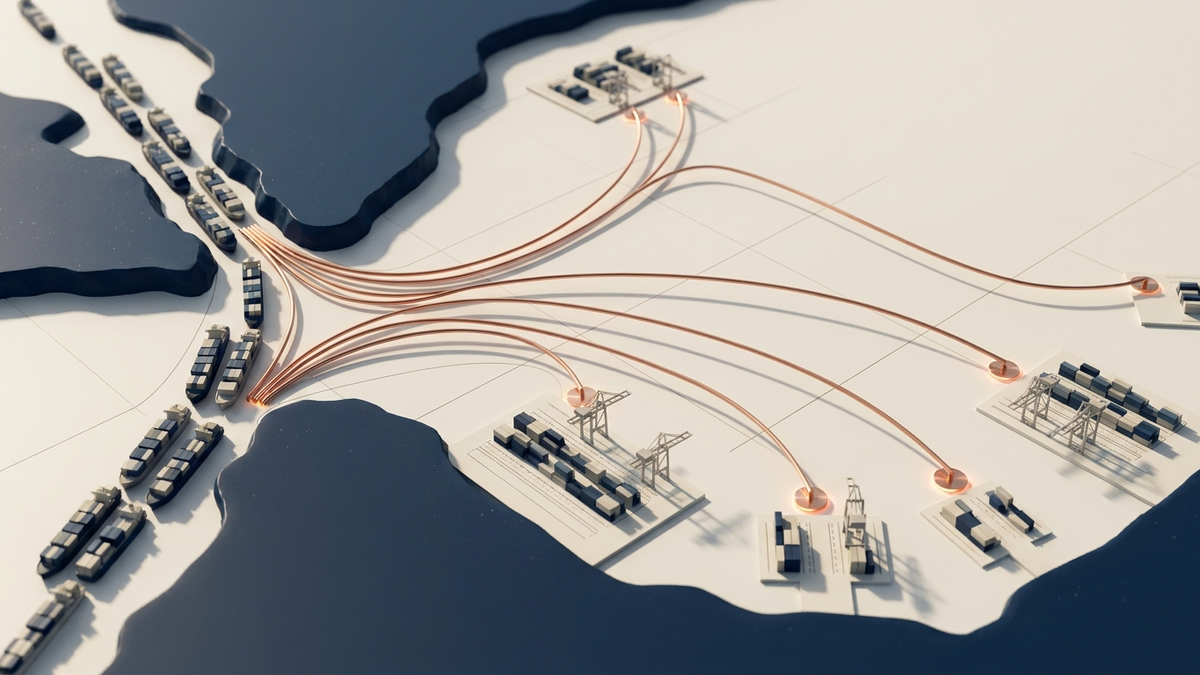
When the Panama Canal restricts draft limits or West Coast port negotiations stall, physical supply chains divert. Standard enterprise resource planning software cannot follow them. The typical monolithic ERP treats a port of entry as a static data field and landed cost as a quarterly average. When a container reroutes from Los Angeles to Savannah, the ERP simply records a late delivery and a cost variance long after the fact. Manufacturers need port diversification supply chain software to model landed costs across alternative ports and dynamically reroute shipments before the container leaves its origin.
We build custom operational software to solve this problem. Instead of forcing your logistics team to manage complex exceptions in fragile spreadsheets, we model your real business logic chains into modular software. This software runs alongside your existing systems. It gives you the operational depth to change routing decisions dynamically and understand the exact cost impact immediately.
The Rigid Architecture of Standard Enterprise Software
A standard ERP expects a linear and predictable world. You enter a purchase order for raw materials. The system assigns a standard lead time based on the origin port and the destination warehouse. It applies a standard freight cost based on annual finance projections.
Port diversification requires contingency planning and immediate reaction. If you route a shipment through the Port of Houston instead of the Port of Long Beach, every downstream variable changes. Drayage costs shift. Rail transit times fluctuate based on localized yard congestion. The final delivery date to your manufacturing facility moves outward or inward.
Off-the-shelf software fails here because these platforms are essentially ledgers designed to record what happened. They lack the operational depth to predict what will happen if you change a single variable in the middle of a transit lane. We see this disconnect in almost every manufacturing operation we analyze. The ERP estimated ship date is re-baselined as schedules slip, which means the ERP ship date is a schedule rather than a fact. It almost never matches the customer requested date and it shows no directional bias.
When logistics teams realize the core system cannot handle dynamic routing, they export their data. They build massive spreadsheets to calculate alternative transit times and costs. This disconnects the routing decision from the operational software entirely. By the time a decision makes it through the spreadsheet and back into the workflow, the vessel cutoff at the origin port has already passed. The opportunity to reroute the freight is gone.
Calculating Real Landed Costs Across Alternative Ports
Landed cost is the ultimate metric for port diversification. A cheaper ocean freight rate to the East Coast often hides higher inland transportation costs. A standard cost metric set annually by a finance department becomes useless the moment a supply chain diverts.
Custom port diversification supply chain software models your specific cost structures accurately. We map your negotiated carrier rates, your historical drayage fees, and your specific warehouse handling charges into the system. We write this as deterministic code. If a decision can be written as an if-statement, we write it as an if-statement. Code determinism is fast, it costs nothing per call, you can test it thoroughly, and it never drifts unpredictably.
When a disruption occurs at a primary port, the software models the alternatives based on your precise rules. It calculates the exact cost per unit if the container discharges in Seattle versus Norfolk. It includes the chassis split fees, the peak season rail surcharges, and the demurrage risk parameters unique to your operation.
This is applied software logic. It fits your operation instead of forcing a process change to match a generic software template. You see the true landed cost for every routing option. You make the routing decision based on accurate margins rather than optimistic standard costs.
Semantic Data Extraction in Logistics Visibility
Visibility requires accurate data from external partners. Carriers and freight forwarders send advance shipping notices, arrival notices, and delay alerts in inconsistent formats. They send emails, scanned PDFs, and flat files.
Template-based document capture relies on fixed layouts per sender. This approach fails immediately when a carrier changes their layout or a new freight forwarder enters your network. Off-the-shelf systems force manual data entry to bridge this gap. This manual work introduces latency. A reroute notice sits in a shared email inbox for two days before anyone keys it into the logistics platform.
We solve this by deploying the ATLAS engine to read unstructured freight updates. The ATLAS engine is owned by SyscallAI and licensed to Aiterated. We build on the ATLAS engine to apply domain-scoped AI directly to your logistics workflow. It extracts the business meaning from carrier emails and PDF arrival notices. It maps the revised estimated time of arrival and the updated port of discharge into a typed record.
This approach is what we call Semantic EDI. As we outlined in our technical breakdown of What Is Semantic EDI, the business meaning is separable from format and transport standards. We use an adaptive parse methodology. A deterministic parser reads what it can. An AI model reads only what the parser cannot settle.
Deterministic software then validates that extracted record against your exact purchase orders, item catalogs, and business rules. An exact match in your company data always outranks a model inference. A learned signal never outranks an exact deterministic match. If the system flags a failed check, it routes the discrepancy to a human operator alongside the source document and the specific reason for the failure. The model never writes directly to your core ERP. A separate downstream check compares what was entered against the source document.
This process digests real-world delays and reroutes instantly. Your logistics software stays perfectly aligned with the physical reality of your freight.
Applying AI to Supply Chain Routing with Strict Boundaries
Implementing AI for supply chain automation requires a highly structured approach to model boundaries. Generic artificial intelligence fails in logistics because it extrapolates outside its given domain. It guesses. In supply chain operations, a guess costs thousands of dollars in misrouted freight.
We use federated models that stay precise at the boundaries. We go deep where generic software stays shallow. This requires rigorous evaluation and decorrelated checking. Every number produced by an operational memory system must be discounted by an adversary with a measured catch rate. You cannot let an AI model autonomously change a port of entry without a completely separate logic gate validating the decision.
We use checkers that fail differently from the producer model. We measure confidence scores rigorously. In our own stack, we measured a confidence score as entirely anti-calibrated. The top confidence buckets needed fixes more often than the bottom buckets. Knowing this allows us to build rigid constraints around how models suggest supply chain decisions. The software presents the port diversification options. The deterministic code calculates the costs. The human operator reviews the modeled realities and executes the routing decision.
Replacing Dashboards with Operational Memory
Visibility software often defaults to providing more screens. This is a mistake. Static dashboards fail in supply chain management because they only report the past. If a ship experiences a delay at the Panama Canal, a dashboard simply turns a transit metric red.
We take a different approach. Static dashboards are kept only as proof or receipts for clients and auditors. Screens built purely for watching are no longer built. Operational software must prompt specific action.
Instead of staring at a map of delayed vessels, internal staff ask operational questions in plain language. They get answers drawn directly from operational memory. A logistics manager can ask the system how many open purchase orders are currently routed through the Port of Long Beach and what the margin impact will be if they are diverted to Seattle. The software pulls the current state, runs the deterministic landed cost calculations, and returns an exact financial summary. This moves the organization from passive monitoring to active supply chain control.
Modular Implementation Without Monolithic Risk
Replacing an entire enterprise system to gain better supply chain visibility introduces unacceptable risk. A typical monolithic upgrade takes years and freezes the business during implementation.
We reject the big-bang cutover entirely. We build custom supply chain software using modular implementation and parallel operation. You keep your current ERP for finance, human resources, and basic inventory ledgers. We deploy the port diversification routing module in increments. It sits alongside your existing systems. It reads purchase order data from your ERP, enriches it with real-time tracking and modeled alternative routes, and feeds the finalized delivery dates back into the core system.
This provides zero-disruption automation. You get faster time to value and drastically lower operational risk. We approach vendor replacement and system upgrades through coexistence. The work is additive and forward-only. We do not perform historical backfills that corrupt clean data. We handle double-send risk by disabling one vendor deployment precisely at go-live. A fix started on a retiring path is withdrawn within minutes. Never fixing the old path is a written rule.
By running the custom module in parallel, you protect your core operations. If a new automated routing release misfires during testing, it only affects the parallel module. Your factory keeps running. Your accounting department keeps closing the books. You gain the advanced routing capabilities you need without betting the entire company on a software migration.
Operations Automation Across the Workflow
When you change a port of entry, the production floor feels the direct impact. Supply chain visibility software is useless if it does not connect to the manufacturing schedule.
We build software for operations-heavy businesses. We model your real workflows directly into the software. Consider our work with High Caliber Line. We built custom extraction plus operations automation across a multi-stage print and manufacturing workflow.
This type of operations automation applies perfectly to port diversification. When raw materials are delayed at a port, the entire production schedule must adjust. By modeling the business logic chains, the software understands the exact material dependencies. A delay in receiving component parts triggers an automatic recalculation of the production queue. The software identifies which jobs have their required materials on hand and moves them to the front of the line.
Generic platforms force your floor managers to manually reconcile delayed shipments against the production schedule. Our custom software bridges the gap. The port routing decision informs the receiving dock schedule. The receiving dock schedule updates the manufacturing queue. The business logic chain connects the ocean container directly to the final assembly station.
Catching Errors Before They Escalate
Port diversification introduces new failure points in data entry. A new port means a new warehouse, a new drayage carrier, and new tax jurisdictions. When customer service or logistics representatives manually update these fields, errors occur.
We analyze how these errors happen. In our own order-to-release automation work, we found that most staff edits either filled fields the source document never had or re-keyed values already captured in the wrong shape. Nearly all address edits involved re-typing information already present on the document.
Custom software eliminates this manual re-keying. The semantic extraction layer captures the new routing details perfectly. The deterministic rules validate the new carrier codes. The system catches logic errors before they manifest as physical routing mistakes on the yard.
We handle customer matching with rigid hierarchy. Exact identifiers always outrank similarity. Fuzzy matching only suggests a relationship. A misroute caused by booking an order to the wrong warehouse or customer domain is prevented by enforcing exact identifier matches. The software protects the operation from the inherent messiness of supply chain data.
The Strategic Imperative for Custom Logistics Software
Failing to diversify ports costs margin. When supply chain teams cannot model alternative routes quickly, they default to expensive contingency plans. They pay premium air freight rates to bypass port congestion entirely. They hold massive quantities of excess safety stock in local warehouses to buffer against unpredictability.
Port diversification supply chain software eliminates the need for arbitrary safety stock. You gain the confidence to route freight dynamically because you know exactly how the alternative route impacts the delivery date and the final unit cost. You see the entire board in real time.
Off-the-shelf ERPs will never provide this capability. They are built to serve every generic business adequately and no specific operation perfectly. Your logistics workflows are your competitive advantage. You need software shaped to your operations rather than software that forces you to abandon your most effective processes.
We deploy in increments. We operate in parallel to your existing systems. We continuously optimize the routing logic based on your actual performance data. We model your business logic chains into custom software that fits.
If your team is managing port delays and alternative routing in disconnected spreadsheets, your operational software is holding you back.
Book a discovery call with us. We will show you exactly how modular software implementation transforms supply chain visibility and protects your manufacturing margins.